Street-Level Magnetism: The Buried Circuits That Decide When Britain Goes Green

You are fourth in the queue at a red light on a wet Tuesday in Leeds. Ahead of you, buried a few centimetres beneath the tarmac, is a rectangle of wire roughly the size of a dining table. It went in the last time the junction was resurfaced, and nobody has looked at it since. It is, in the most literal sense, the reason you will eventually move.
Street furniture gets noticed. Traffic loops don't. They are the most-trodden piece of physics in the country and almost nobody has knowingly stood on one.
The scar you've stepped over a thousand times
Look closely at the road at a signalised junction and you'll spot them: thin dark lines cut into the surface, often in a rough rectangle or a pair of them, sealed with a bitumen-based compound that ages slightly faster than the surrounding asphalt. Road engineers call the repairs "tar snakes". The lines trace a groove a few millimetres wide, cut with a diamond saw, into which contractors lay several turns of insulated copper wire. A feeder cable runs from one corner, through a duct, to a grey cabinet on the pavement.
Sizes vary with the job. A stop-line loop might be a couple of metres by one; a motorway lane loop similar; a directional pair set a few metres apart so the electronics can work out which way you went. What they share is a job description so simple it barely sounds like science: notice when something metal is sitting on top.
An oscillator that dislikes company
The loop isn't a magnet and it doesn't emit a field you could feel. It's an inductor — a coil — wired into an oscillator circuit inside the roadside detector card. Left alone, the circuit hums along at a set frequency, typically somewhere in the tens to hundreds of kilohertz.
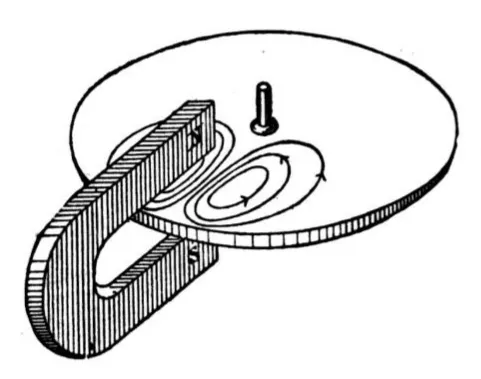
Bring a car over the top and two things happen at once. Ferrous metal concentrates the magnetic field, which tends to raise the coil's inductance; eddy currents induced in the bodywork and chassis set up their own fields that push back, which tends to lower it. The net result depends on the vehicle, the height of its underside and the geometry of the loop, but it is a change — a fraction of a per cent is plenty. The oscillator's frequency shifts, the detector compares that shift against a baseline it has been quietly maintaining, and a vehicle is declared present.
The clever part isn't the sensing. It's the ignoring. Detector cards spend their lives compensating for temperature swings, wet salt spray, grit, resurfacing and the slow creep of a coil settling into old asphalt. A loop that cried wolf every time the road got cold would have traffic engineers ripping up tarmac for a living.
Why the lights so often ignore your bicycle
Loops are tuned to a design vehicle, and the design vehicle is a car or a van. A bicycle has very little metal, sits high in places, and may have carbon-fibre components with none at all. A small aluminium rim passing over a coil designed to feel two tonnes of steel is a whisper in a noisy room, and if the sensitivity threshold sits above that whisper, the junction doesn't know you're there.
This is a known irritant rather than a mystery. Many councils respond by fitting high-sensitivity detectors on cycle approaches, painting the road with a bicycle symbol above the loop so riders know where to stop, or retaining a push-button on the pavement. Others simply accept the button. If you ride, the practical advice is dull but real: put your wheels and frame directly over the painted mark rather than a metre short of it, because the sensitivity falls off sharply outside the loop.
Motorcyclists hit a smaller version of the same problem. Less metal, less coupling, and a habit of stopping in the gap between two loops. Stopping with the engine over the paint, rather than the back wheel, usually does the job. Some detector cards can be set to a motorcycle profile, which is why a junction that ignores one bike might pick up the next.
From a pulse to a congestion map
At a junction, a loop is a switch. On a motorway, it's a census. The MIDAS system — Motorway Incident Detection and Automatic Signalling — uses loops buried in each lane at regular intervals to count and classify passing vehicles, pairing two loops a short distance apart to work out speed and length. That's what feeds the variable speed limits and the queue warnings on the gantries above the M25 or the M62.
In towns, the SCOOT system — developed by the Transport Research Laboratory and in use across hundreds of UK junctions since the 1980s — uses loop data to nudge green times second by second rather than running a fixed timetable. The result is fewer cars idling at empty junctions, and a stream of anonymous numbers flowing into local authority traffic models, open data portals and the journey-time estimates on your satnav.
What the loops don't know about you
An inductive loop reports occupancy and, with a bit of processing, an approximate vehicle class. It does not read a number plate, see a face or notice a phone. It cannot tell your Vauxhall from an identical one two streets away, and it forgets a vehicle the moment the field settles back to baseline.
That's worth saying plainly, because "sensors under the road" sounds like the opening of a much gloomier article. Number-plate recognition is a separate technology, in separate cabinets, governed by its own rules and the surveillance camera code of practice. Inductive loops are closer to a tally counter than a camera.
The fairer privacy question is about aggregation. A decade of counts per lane, per minute, builds a detailed picture of how a place moves — and models built on it shape where money goes and which junctions get remodelled. That data is about roads rather than people, but it isn't nothing.
The next time the light changes
Stand at a junction and look down. Those dark lines in the tarmac are a physics experiment running continuously since the resurfacing gang left, and its output is the green light you'll take for granted. It's not magic, and it's not a camera. It's a coil, a frequency, and a very patient piece of electronics deciding that the field just changed — and that you, probably, are a car.