Mud, Magnetite and a Microscope: Britain's Pond Bacteria That Follow the Field
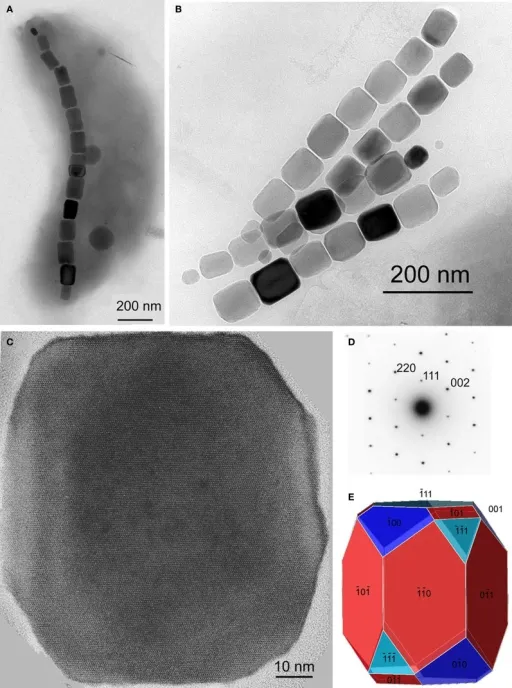
Photo: Mihály Pósfai, Christopher T. Lefèvre, Denis Trubitsyn, Dennis A. Bazylinski, and Richard B. Frankel, CC BY 3.0, via Wikimedia Commons
On a damp autumn afternoon, a British pond can look like a fairly ordinary place: duckweed, drizzle, a moorhen making a fuss in the reeds. But down in the sediment, where the mud turns dark and the oxygen runs out, there are microbes doing something quietly extraordinary. Some of them grow their own magnetic crystals, string them into a chain, and use Earth's magnetic field as a steering aid. They are magnetotactic bacteria, and they are among the strangest examples of magnetism in living things.
A compass made of crystals
Magnetotactic bacteria are a loose grouping of aquatic bacteria rather than a single species. What unites them is the magnetosome: a small, membrane-bound compartment inside the cell where the bacterium builds a crystal of a magnetic iron mineral. Most commonly this is magnetite, an iron oxide better known to geologists as Fe3O4. Some species make greigite, an iron sulphide. These crystals are tiny, often a few tens of nanometres across, and they sit in a chain inside the cell.
The chain is the clever bit. A single crystal would wobble about in the weak pull of Earth's field. A chain of them, all lined up, gives the cell a stronger magnetic moment, so the whole bacterium tends to align with the local field lines like a tiny compass needle. The bacterium is not thinking about north. It is simply being nudged into line by physics, then swimming along that line with its flagella.
Why swim along the field?
The usual explanation is oxygen. Many magnetotactic bacteria are microaerophiles: they like a little oxygen, but not too much. In a pond, the right conditions often sit in a narrow band just below the surface sediment, where oxygen-rich water meets oxygen-poor mud. Finding that band by random swimming would be a slog. Using the geomagnetic field as a guide makes it easier.
In Britain, the magnetic field points into the ground at an angle, not flat along the surface. A bacterium that swims along the field line in the northern hemisphere will tend to head downwards, towards the sediment and the low-oxygen zone. In the southern hemisphere, the field dips the other way, and many cells there swim in the opposite direction. Near the equator, where the field is more horizontal, you find a mix of behaviours. It is a neat reminder that Earth's magnetism is not just a map for sailors; it is part of the physical landscape for pond life.
Where in Britain?
You do not need a remote wilderness. Magnetotactic bacteria have been found in ponds, ditches, slow canals, gravel pits, salt marshes and wetland sediments around the world. In the UK, the Norfolk Broads, the Somerset Levels, muddy farm ponds and quiet corners of country parks are all plausible places to look. They tend to hang around the oxic-anoxic transition zone, the boundary between water with oxygen and sediment without it. That is often just a few millimetres below the surface of the mud.
They are not alone down there. Pond sediment is a crowded, chemically busy place, full of iron cycling, sulphur chemistry and microbes jostling for position. Magnetotactic bacteria are part of that hidden economy, not a separate curiosity.
Nature's nanoparticle factory
Building a magnetosome is not simply a matter of collecting rust. The bacterium has to take up iron, control its oxidation state, and keep the crystal size and shape within a narrow range. Proteins in the magnetosome membrane do much of the chemical handling, while other proteins help organise the chain. The result is a biological nanoparticle with a surprising amount of quality control.
That is why materials scientists are interested. Magnetosomes are uniform, membrane-coated and magnetic, which makes them attractive for research into magnetic separation, targeted delivery and imaging. The caveat is familiar: what works beautifully in a bacterium is not automatically a scalable technology. Still, as a model of controlled biomineralisation, the magnetosome is hard to beat.
Why they matter beyond the pond
Magnetotactic bacteria matter to geologists because their crystals can be preserved in sediments as magnetofossils. These tiny magnetic particles can contribute to the magnetic signal of mud and rock, which is one of the ways scientists try to read ancient environmental conditions. The evidence is not always straightforward. Detrital grains, chemical precipitates and bacterial crystals can all leave magnetic traces, so researchers have to be careful about what they attribute to biology.
There is also a bigger, more speculative link to early life. Some ancient rocks contain magnetite crystals that have been argued to resemble bacterial magnetosomes, but the claim is debated. Magnetism can offer clues to the history of Earth's field and to the environments where early microbes might have lived, but it rarely gives a clean, single answer. That uncertainty is part of the science, not a flaw in it.
Looking for them without a laboratory
You cannot see magnetotactic bacteria with the naked eye. They are microbes, and even a good pond sample will not announce itself with a magnetic party trick. But with a hobby microscope and some patience, you can make a reasonable attempt.
Take a clean jar and collect a small amount of surface sediment and the water immediately above it from a pond edge. Let it settle. Then place a strong magnet against the outside of the jar for an hour or so. Some magnetic particles and magnetotactic cells may collect near the magnet. Take a drop from that area, put it on a slide, and look under the microscope. A magnification of 400x is a sensible start; 1000x is better if you have it.
What might you see? Tiny rod-shaped or spherical cells, sometimes moving in a loose line or gathering at a particular edge of the drop. It is not a definitive test. Many things in pond mud are magnetic or sticky, and plenty of bacteria will ignore the field entirely. Proper identification needs laboratory methods. But as a weekend exploration, it is a good way to make the invisible feel a little more real.
A few sensible cautions: do not disturb protected sites, get permission where needed, avoid stagnant water if you have cuts, wash your hands afterwards, and do not drink the sample. Pond mud is alive in more ways than one.
The magnetotactic bacteria in Britain's ponds are a useful antidote to the idea that magnetism belongs only to compasses, railways and spacecraft. Earth's field reaches into the mud, and some of the smallest organisms around have evolved a way to use it. That is worth a closer look.