No Pads, No Squeal: The Case for Magnetic Brakes on Britain's Rails
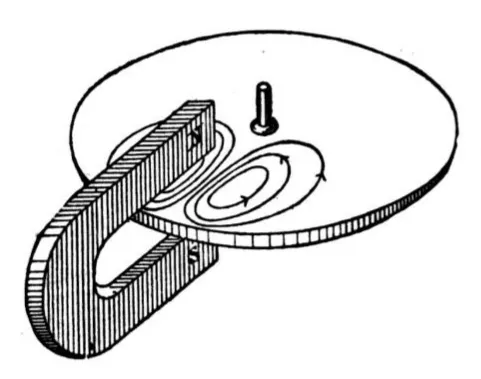
Photo: Silvanus Phillips Thompson, CC0, via Wikimedia Commons
A brake that doesn't rub
Most brakes work by making one thing rub against another. Pads clamp discs, blocks press on wheels, and the train's momentum is converted into heat and noise. It is effective, familiar and slightly grubby. Eddy-current braking does something stranger: it slows a train by using magnets to stir electricity inside metal. Nothing touches. Nothing wears away. The only real exhaust is warmth.
The idea sounds futuristic, but the physics is old and rather elegant. If you move a conductor — a metal that lets electrons roam — through a magnetic field, or move a magnet past a conductor, you induce electric currents inside the metal. These are eddy currents: swirling loops of charge named after the way water curls in a stream. They don't need wires or batteries. The motion itself does the work.
And because those currents create their own magnetic fields, they push back against the motion that made them. That is Lenz's law in action: the induced effect opposes the change that caused it. In a train, that opposition feels like braking.
Why motion turns into heat
The energy has to go somewhere. As eddy currents flow through the metal's natural resistance, they heat it up. So a magnetic brake is really an energy converter: movement goes in, electricity swirls around, heat comes out. No brake dust, no pad material slowly disappearing, no squeal from a metal-on-metal interface.
In practice, an eddy-current brake usually means powerful electromagnets mounted close to a conductive rail or a dedicated reaction plate. Energise the magnets, and the train's own forward motion generates the braking force. Switch them off, and the effect largely vanishes. There are no pads to replace and no hydraulic fluid to leak. For operators, that is an appealing maintenance story.
There is a catch, though — several, in fact. The braking force depends on speed. At high speed, the eddy currents are strong and the retardation is useful. As the train slows, the effect fades. An eddy-current brake is therefore not a complete replacement for conventional friction brakes. It is a partner: excellent for shedding speed, less useful for the final creep into a platform or for holding a train still on a gradient.
Where you've already met the effect
You may have experienced eddy-current braking without noticing. Modern roller coasters and fairground rides often use magnetic brakes because they are smooth, controllable and don't rely on rubbing parts that wear out. The train-shaped carriage races past a row of magnets, the metal fins on the car heat up, and the ride settles into the station with a sense of being gently but firmly reined in. It is a very visible demonstration of invisible physics.
Specialist rail systems and people movers have also used magnetic braking where quiet operation and low maintenance matter. Abroad, some high-speed trains have employed eddy-current brakes as supplementary stopping power. In Britain, the technology has appeared in trials, test rigs and niche applications, but it has not become a standard feature of the mainline fleet.
That gap is worth thinking about. Britain's railways already use another kind of clever braking: regenerative braking. On electric trains, the traction motors can run in reverse as generators, turning motion back into electricity and feeding it into the overhead line or third rail where conditions allow. That is genuinely efficient, but it is not the same as eddy-current braking. Regenerative systems recover energy; eddy-current brakes mostly dissipate it as heat. They solve different problems.
The real reasons it hasn't taken over
If magnetic brakes are quieter and lower-maintenance, why aren't they everywhere? The answer is a familiar railway mix of physics, engineering and economics.
First, heat management. A heavy train has a lot of kinetic energy, and an eddy-current brake turns much of it into warmth in the rail or reaction plate. Managing that heat without distorting track components or creating hotspots is not trivial. Friction brakes have their own heat problems, but they put the hot parts on the train, where engineers can design for them.
Second, weight and power. Powerful electromagnets are not featherweight. They need electrical supply, control gear and cooling. On a train already packed with equipment, that is a real cost.
Third, safety cases. Rail braking must be fail-safe and predictable in rain, snow, leaves and low-speed shunting. Eddy-current brakes are speed-dependent and need fallback friction brakes. Adding a system that cannot stop the train on its own complicates the design rather than simplifying it.
Fourth, infrastructure. Some eddy-current systems rely on a conductive reaction rail or a carefully positioned track component. Retrofitting that across Britain's mixed network — with its varied track, signalling and rolling stock — is a serious undertaking.
None of this makes eddy-current braking a bad idea. It makes it a specialist tool. The strongest case may be for particular duties: high-speed sections where supplementary braking reduces wear, enclosed stations or tunnels where brake dust and noise are unwelcome, or applications where maintenance access is difficult.
A quieter kind of stopping power
The eddy-current brake is a lovely piece of physics because it asks nothing extra of the world. No consumable pads, no chemical reactions, no contact. Just magnets, motion and the stubborn tendency of electricity to resist being pushed around. It won't replace the humble friction brake on Britain's trains any time soon, and it shouldn't. But as rail looks for quieter, cleaner and lower-maintenance engineering, the brake that never touches deserves more than a passing glance.