The Pounce Test: Do Britain's Foxes Really Read the Magnetic Field?
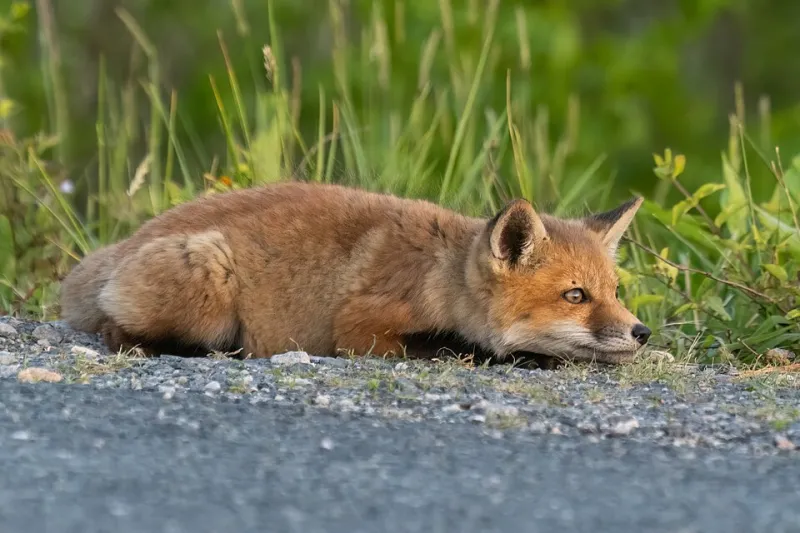
Photo: Rhododendrites, CC BY-SA 4.0, via Wikimedia Commons
A red fox hunting in a snow-covered field does something oddly deliberate. It listens, tilts its head, shuffles a step or two — then launches itself almost vertically and comes down nose-first. In 2011, a team of Czech researchers published a startling claim about those leaps: the foxes appeared to be more successful when they pounced towards the north-east. That one observation turned a familiar piece of countryside behaviour into the most-repeated story in the science of magnetoreception. Fifteen years on, it is worth asking what the evidence actually supports — and what a British fox has to do with any of it.
A statistic that travelled further than the fox
The study, published in Biology Letters, was led by Jaroslav Červený and included Hynek Burda, a zoologist who has spent decades chasing magnetic behaviour in mammals. Over two winters, observers watched red foxes hunt small rodents under snow and recorded the compass direction of each pounce alongside whether it ended in a catch. The headline number was striking: leaps aimed roughly north-east succeeded far more often than leaps in other directions, something in the region of three-quarters of the time against three-fifths.
It is a lovely result. It is also, by the standards of behavioural ecology, a small and awkward one. The sample ran to a few dozen usable pounces, gathered by multiple observers across several sites, and it included foxes held in enclosures as well as wild ones. Success was judged by eye, at distance, often in poor light. None of that makes the finding wrong — plenty of good science starts this way — but it means the result is a clue, not a conclusion.
Two ways an animal could taste the field
Before weighing the fox story, it helps to know what a magnetic sense would even consist of. There are two serious candidates, and they are not variations on a theme.
The first is mineral. Certain bacteria build chains of magnetite crystals that act like a compass needle, and magnetite has been found in the tissue of various animals, including fish and birds. The idea is that tiny iron-oxide crystals could twist in response to the geomagnetic field and tug on a mechanoreceptor nearby. It is beautifully physical: a compass you could, in principle, photograph.
The second is chemical, and stranger. In the radical-pair mechanism, light striking a protein called cryptochrome in the retina sets off a reaction whose outcome depends on the orientation of the molecule relative to Earth's field. In effect, the animal may see the field — or see a visual overlay that shifts as it turns. Researchers at Oxford have spent years on the quantum chemistry of this, because the mechanism is genuinely counter-intuitive: it depends on magnetic effects far too weak to nudge a compass needle but apparently strong enough to alter a chemical reaction rate.
Both ideas have support. Neither has been nailed down in mammals.
The awkwardness of watching animals
Critics of the fox study have made a few pointed observations. Pouncing foxes are not randomly oriented — they turn towards sounds, and they may orient to the sun, to the slope, or to the wind. An observer who can see a pounce but not always see whether it succeeded will tend to record the visible, dramatic leaps and miss the failures. And if the wind in a study area blows mainly from one quarter, a directional bias in pouncing could reflect nothing more exotic than scent drifting across a field.
Later reanalyses argued that the north-easterly preference could be explained by such factors without any magnetic component at all. The original authors pushed back, and the field has never quite resolved it. What you have, in truth, is one suggestive dataset that has never been convincingly replicated at scale.
Meanwhile, in a British back garden
Britain has roughly a few hundred thousand adult red foxes, and a great many of them live in towns. They are, conveniently, one of the few wild mammals most of us can watch from a kitchen window. So why hasn't anyone run the pounce test in Leeds or Cardiff?
Partly because urban foxes hunt mostly by sound and smell in gardens where snow is rare, and partly because the observations are tedious to make properly. But there is a deeper reason: the UK's magnetic field is not a fixed backdrop. Magnetic north drifts relative to true north, and the angle between them varies across the country and changes year by year. Any animal navigating by a magnetic map has to recalibrate it — which is one reason researchers are cautious about treating a compass reading as a permanent, hard-wired thing.
There is much better British-adjacent evidence from birds. Garden robins, ringed in their thousands by volunteers, show directional preferences that shift when the magnetic field is manipulated experimentally — the classic signature of a magnetic sense. That work is a decade-spanning edifice. The mammal version is a shed.
What would actually count as proof
If you wanted to settle the fox question, you would not simply watch more foxes. You would put an animal in a room where the magnetic field can be rotated by coils while smell, sound and light are all controlled. You would score pounces blind, with video, so nobody knows which condition they are watching. You would check whether removing the sense of smell changes anything, and whether a false magnetic cue misleads the animal in the same way a real one does.
That kind of experiment has been done with birds and with a handful of mammals. It has not been done with foxes, and it is not obvious that anyone will bother. Foxes are not a convenient laboratory species, and the payoff would be a single line in a very long argument.
So what should we actually believe?
A fair summary: magnetoreception in migratory birds is well supported, if still mechanically uncertain. In mammals the evidence is thinner and more contested — a widely reported study suggesting dogs align north-south while defecating failed to replicate cleanly, and the celebrated north-south alignment of grazing cattle and deer has been disputed on statistical grounds.
The fox is a hypothesis wearing the costume of a fact. It might turn out to be right. But the interesting part is not whether it is; it is that a single field season, a few dozen leaps and a compass bearing were enough to lodge a claim in the public imagination for fifteen years. That is a lesson about how science travels, and it applies well beyond a snowy field in Central Europe.
Next time you watch a fox go quiet, head cocked, front paws lifted, watch which way it faces. Write it down. Note the wind. Note whether it caught anything. That notebook is, genuinely, where this question lives — and British gardens are as good a place as any to start filling it.