The Compass Points Somewhere Else: Why Britain's Magnetic North Won't Sit Still
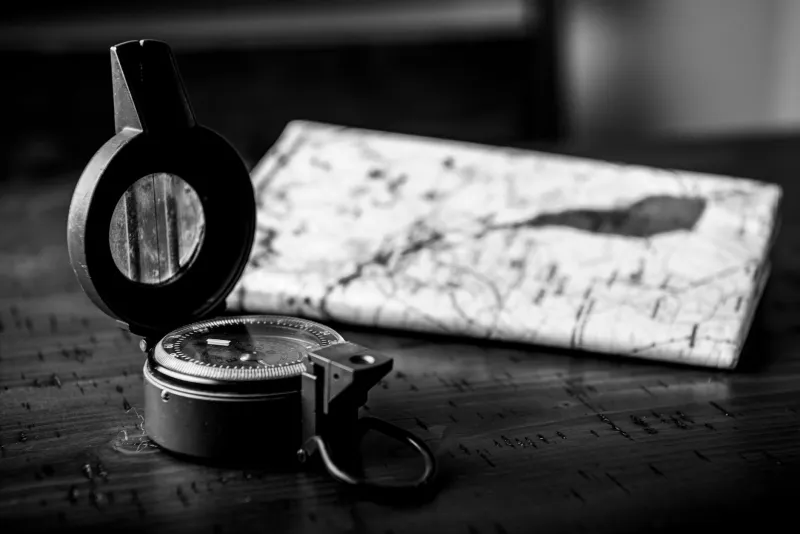
Stand on a hillside in the Carneddau with a paper map, a baseplate compass and a raincloud closing in, and you are quietly juggling three different ideas of north at once. True north runs through the planet's axis of spin. Grid north is the tidy fiction printed on the map, all those neat parallel blue lines. And magnetic north is wherever your needle decides to lean today — which, inconveniently, is a moving target.
The needle isn't pointing at a place
It is tempting to imagine a lump of magnetic rock buried somewhere in the Arctic, hauling compass needles towards it. That picture is wrong in a useful way. A compass needle aligns itself with the local direction of Earth's magnetic field, and the 'magnetic north pole' is simply the spot where that field points straight down into the ground. It is a geometric feature, not an object. Move the field and the pole moves with it.
There is an even better pub fact lurking here. Because field lines leave the southern hemisphere and re-enter in the north, the pole near Canada is, magnetically speaking, a south pole. Physicists have known this for decades; cartographers have politely ignored it.
The engine room, 2,900 kilometres down
Everything above rests on something nobody has ever seen. Beneath the rocky mantle sits an outer core of liquid iron and nickel, roughly 2,900 kilometres below your boots and hotter than the surface of the Sun. It churns. Heat rising from the inner core drives convection, the planet's rotation twists the rising plumes into spirals, and moving molten metal carries electric currents — which generate magnetic fields, which drive more currents. The whole assembly is called the geodynamo, and it has been running for billions of years without maintenance.
Because the flow is turbulent rather than tidy, the field it produces is lumpy and forever rearranging itself. Geophysicists call that slow rearrangement secular variation. Occasionally the field twitches sharply over a year or two, an event known, charmingly, as a geomagnetic jerk.
One pole, a couple of thousand kilometres of travel
In 1831, the explorer James Clark Ross located the north magnetic pole on the Boothia Peninsula in Arctic Canada. Since then it has wandered well over 2,000 kilometres, drifting out of Canada and across the Arctic Ocean towards Siberia. Its speed has been anything but constant: it accelerated sharply through the 1990s and 2000s, reaching a pace of tens of kilometres a year, before slackening somewhat in the past decade.
That acceleration caused a small administrative headache. The World Magnetic Model, the mathematical description of the field used by navies, aviation and mapping agencies, is normally refreshed every five years. In 2019 it needed an out-of-cycle update because the pole had outrun the model. The current edition runs to 2030, and the British Geological Survey is one of the organisations that helps build it.
What this means on a British footpath
Magnetic declination — or, if you are using an Ordnance Survey map, the grid magnetic angle — is the gap between magnetic north and the north your map cares about. Get it wrong and your bearing is wrong by the same amount, which on a featureless moor in clag is the difference between the summit and a bog.
Britain has had a ringside seat for some dramatic declination history. In the early 1800s, London's declination was roughly 11 degrees west. It shrank steadily through the Victorian era, crossed zero in the 2010s, and now sits within a degree or two of true north for most of the country. That means the classic schoolroom instruction to 'add or subtract a few degrees' is, at the moment, nearly a no-op across much of lowland England.
Nearly. Declination varies across the UK, and it changes year on year. It also will not always be this tame — in a few decades the correction will be worth taking seriously again. Setting the value on an adjustable compass and then forgetting it for fifteen years is how errors creep back in.
How the mapmakers keep the paperwork straight
Agencies such as the British Geological Survey run magnetic observatories at Lerwick, Eskdalemuir and Hartland, where instruments record the field continuously, second by second, far from traffic and power lines. Those records are combined with data from repeat stations, where surveyors re-measure the field every few years, and from satellites such as the European Space Agency's Swarm mission, which sample the field from orbit.
From all that, the BGS can calculate declination for any postcode on any date — including dates in the past, which is why you can reconstruct what a 1950s map was really telling you. Ordnance Survey supplies the other half of the equation: a grid tied to a reference frame, with grid convergence values so that a bearing taken from the map can be translated into something a walker can follow. The two systems have to agree, and the agreement is re-derived as the field drifts.
Older OS maps used to print a magnetic north arrow with an annual change figure beside it. Those arrows were a snapshot, valid for a year or two at best, and the drift has since made them historical curiosities rather than navigation aids.
Five things worth doing before your next walk
- Look up the current declination for your area and the date you are walking, not the date the map was printed.
- If your compass has an adjustable declination scale, set it — then note the setting and the year in pencil inside your map case.
- Check whether you are correcting from magnetic to grid or grid to magnetic. Getting the direction of the correction backwards doubles the error rather than cancelling it.
- Remember that a GPS unit knows where it is but not which way you are facing; the heading arrow on a phone usually comes from the magnetometer, so it inherits all of the above.
- Practise on a familiar hill in good weather, where a two-degree mistake costs you nothing but a detour.
The restlessness is the point
The field has flipped poles hundreds of times in Earth's history, most recently around 780,000 years ago, and the geological record suggests the transitions were messy rather than catastrophic. There is no sign of an imminent reversal, and none of this should keep you awake. But it is worth appreciating that the compass in your hand is reading a live signal from a churning ocean of metal, one that shifts under cities, drags charts out of date and occasionally forces an international model to be rewritten ahead of schedule.
The map is a snapshot. The planet is the film.