The Magnet in the Nacelle: Britain's Wind Power Has a Recycling Reckoning
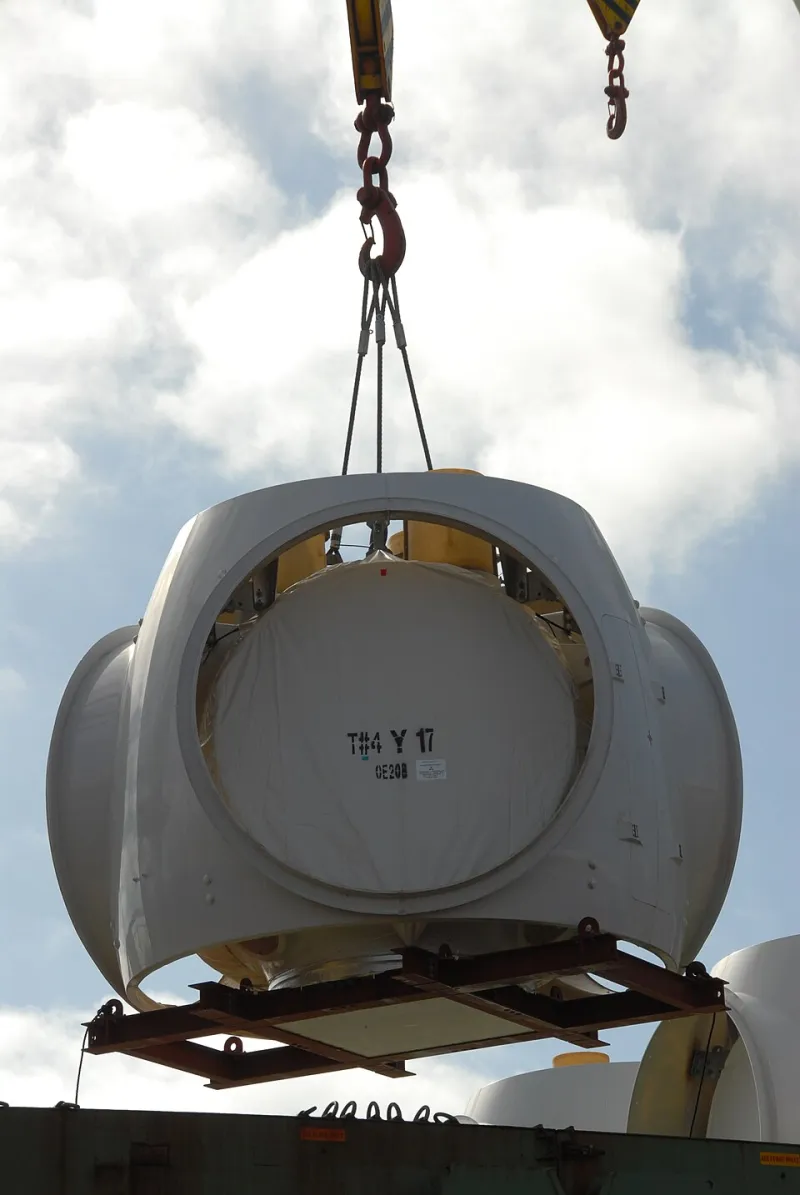
Photo: Dale Frost of the Port of San Diego from San Diego, CA, CC BY 2.0, via Wikimedia Commons
On a blustery day off the Yorkshire coast, a wind turbine looks like a piece of landscape. White tower, slow blades, a nacelle that could be a bus with ambitions. Inside that nacelle, though, is a magnet story that stretches from rare-earth mines to recycling labs in the Midlands. And as Britain's offshore wind fleet gets older, that story is about to reach its awkward second act.
Most people associate wind power with blades, gearboxes and cables. Fair enough. But some of the most important hardware in a modern turbine is a set of powerful permanent magnets, usually made from neodymium-iron-boron. In a direct-drive generator, those magnets help create the magnetic field that turns rotation into electricity without the need for a separate copper excitation system. Fewer moving parts, less maintenance, and a useful efficiency edge — especially when you are repairing something 100 kilometres out at sea.
From ore to nacelle
The magnet's journey begins far from Britain, in rare-earth mines and separation plants. Neodymium, praseodymium, dysprosium and terbium are not especially rare in the Earth's crust, but they are chemically awkward to separate and refine. That is why the supply chain is concentrated in a small number of countries and why rare-earth magnets have become a strategic concern for governments from London to Tokyo.
The UK does not mine much rare earth, and it does not currently host a large-scale commercial magnet supply chain. Instead, British wind farms import finished magnets inside generators built by global manufacturers. There have been attempts to rebuild parts of the chain here, including planned rare-earth processing on Humberside, but the country remains a price-taker in a market dominated by a handful of producers.
That matters because a multi-megawatt direct-drive turbine can contain more than a tonne of permanent magnet material. Larger designs can run to several tonnes. The magnets themselves are not huge slabs of shiny metal; they are often stacked in carefully engineered shapes, bonded or encapsulated, and built into a generator that weighs hundreds of tonnes. By the time a turbine retires, the magnet is not sitting in a neat box. It is part of a complex machine.
Why wind farms love permanent magnets
The appeal is straightforward. Permanent-magnet generators can be more compact and more efficient than electrically excited alternatives, and they need less maintenance. For offshore wind, where every vessel trip costs money, that is a serious advantage. The magnet does the quiet work of creating a strong magnetic field without a power supply.
There is a catch, of course. The same properties that make rare-earth magnets useful also make them politically and economically sensitive. Prices can swing. Export rules can change. Manufacturers have experimented with ferrite magnets, hybrid designs and other workarounds, but for large direct-drive machines the neodymium-iron-boron magnet remains the benchmark.
The retirement problem
A wind turbine is typically designed to last around 20 to 25 years. Some of Britain's earliest offshore projects are already approaching the point where operators must decide whether to repower, refurbish or decommission. Onshore, the picture is even more mixed, with older farms scattered across the country.
Blade recycling gets most of the headlines, because blades are big, visible and difficult to break down. Magnets are less visible but arguably more valuable. They contain critical materials that could be recovered and used again — if the right systems exist to collect, dismantle and process them.
That is a big if. A generator may be shipped to a yard, cut open and separated, but the magnets inside are often coated, glued or assembled in ways that make clean recovery difficult. If a whole generator is shredded, the rare-earth content gets diluted among copper, steel and other materials. Recovery then becomes an expensive chemical puzzle rather than a straightforward recycling job.
The labs trying to close the loop
This is where the quieter end of British materials science comes in. Research groups and pilot projects are looking at short-loop recycling, where magnet scrap is processed back into usable magnetic powder rather than being broken down all the way to individual rare-earth elements. One well-known approach uses hydrogen to embrittle neodymium-iron-boron magnets, allowing them to be separated and milled into powder. The University of Birmingham's magnetic materials work has been part of this wider effort, alongside other UK groups exploring separation, remelting and magnet-to-magnet recycling.
The appeal is obvious. If you can recover a magnet alloy and turn it back into a magnet, you skip some of the most energy-intensive and chemically messy steps of the supply chain. It is not a complete answer — contaminated scrap, mixed alloys and inconsistent feedstocks all cause problems — but it is a start.
There is also a design lesson here. If turbines were built with disassembly in mind, magnets could be removed more cleanly at end-of-life. A digital passport for a generator, listing materials and dismantling steps, sounds dull until you imagine a recycling plant trying to work out what is inside a 20-year-old nacelle.
What happens next
In 2026, the UK is still in the early stages of building a circular economy for wind-turbine magnets. Policy is patchy, collection logistics are immature and the economics depend on rare-earth prices that nobody can predict with confidence. But the direction of travel is clear. Critical minerals are now a mainstream concern, and wind farms are part of that conversation.
The magnet buried in a British wind farm is not just a component. It is a store of scarce materials, a piece of geopolitical supply chain, and a test of whether the UK can plan for the full life of its renewable infrastructure. When a turbine retires, its magnets should not quietly disappear into a shredder. They should have somewhere better to go.