The Wire Around the Room: How Britain’s Hearing Loops Keep Talking Without Bluetooth
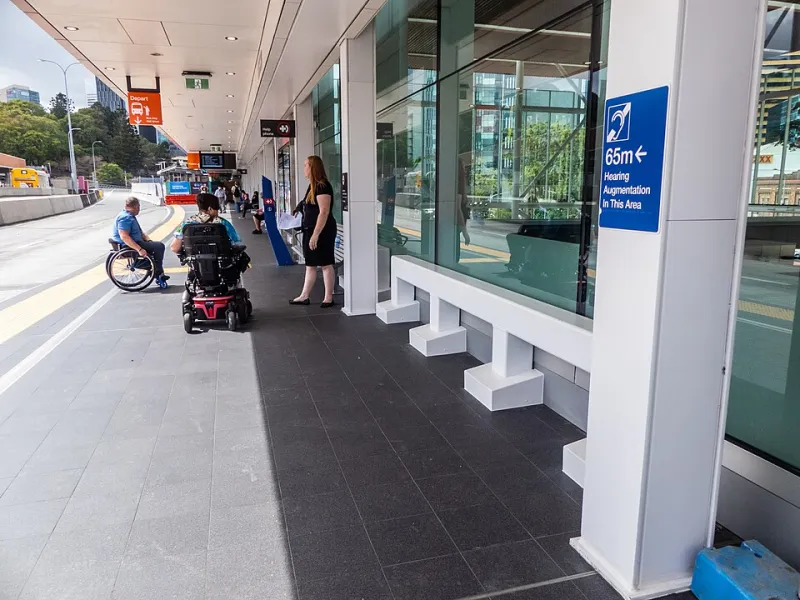
Photo: John Robert McPherson, CC0, via Wikimedia Commons
Walk into a British theatre, bank branch or village hall and you may spot a small blue sign showing an ear and a letter T. It is one of the least dramatic pieces of accessibility hardware in the country: no screens, no pairing menus, no app. Yet behind that sign is a magnetic system that has been carrying sound to hearing aids for decades — and in 2026, it is still being installed.
The loop is a wire, not a loudspeaker
An induction loop system starts with a length of wire run around the edge of a room, under a carpet, through a ceiling void or across a ticket counter. An amplifier feeds an electrical current through that wire. The current is not a simple hum; it is the audio signal itself, varying in strength and frequency as someone speaks, plays music or announces a train platform.
Any changing current produces a changing magnetic field. That is the ordinary physics that also makes transformers and electric motors work. The loop turns the whole room into a weak, audio-shaped magnetic field. It is not a broadcast tower and it is not a permanent magnet. The field collapses and rebuilds many times a second, following the speech or music.
Inside a compatible hearing aid, a tiny component called a telecoil — usually just a coil of fine wire around a core — sits ready to pick that field up. When the magnetic field changes, it induces a small voltage in the telecoil. The hearing aid amplifies and processes that signal, and the wearer hears the venue’s audio directly, without it first travelling through the air to a microphone.
Why the “T” setting still matters
Most hearing aids with a telecoil can be switched to a “T” programme, sometimes alongside the normal microphone setting. In that mode, the hearing aid is listening to magnetism rather than sound waves. The advantage is simple: the signal arrives before room acoustics have had a chance to smear it. Reverberation, background chatter and the distance from the stage matter much less.
That is why loops are still common at ticket desks, church pulpits, lecture theatres and cinema screens. A counter loop at a railway station can lift a clerk’s voice out of the hubbub of a concourse. A room loop in a church can make a sermon clearer in a stone building where sound bounces around for seconds. The telecoil does the work passively, using no extra battery in the hearing aid beyond what the aid already uses.
It is also a useful myth-buster: the telecoil is not a magnet attracting nearby metal, and it does not “receive” magnetism in the way a radio receives a station. It responds to a changing magnetic field, and the loop is engineered to produce one that is strong enough and even enough across the listening area.
The Bluetooth question
Bluetooth hearing aids and the newer Auracast broadcast audio standard are often presented as the future of accessible listening. They are impressive, and they are spreading. But they are not a straight swap for a loop in every British venue.
A loop works with any hearing aid that has a telecoil, regardless of make, model or age. The user does not pair, charge a separate receiver or negotiate a menu. They switch to T and listen. That universality is why loops have survived the smartphone era. They are also relatively cheap to fit in a room that already has a sound system, and they do not depend on the venue’s Wi-Fi or on a phone app being updated.
Bluetooth has real advantages — stereo audio, no loop overspill into neighbouring rooms, and the ability to serve people who do not have a telecoil. But it also asks more of the listener and the venue. In 2026, the sensible approach in many public buildings is not “loops or Bluetooth” but both, with clear signage explaining what is available.
What UK rules actually ask for
The legal picture is not built around one technology. The Equality Act 2010 requires service providers and public bodies to make reasonable adjustments for disabled people, and that can include providing an effective hearing enhancement system. Building Regulations Approved Document M, which covers access to and use of buildings in England, also expects hearing enhancement systems in certain new and altered buildings where amplified speech is provided. Similar requirements exist in the devolved nations.
The wording tends to be about the outcome — can a hearing aid user access the sound? — rather than mandating a particular brand or standard. In practice, that has kept induction loops in the toolkit, especially for refurbishments of older buildings where a wired loop is straightforward and robust.
There is a catch, though. A loop is only as good as its installation. A wire run too far from the listener, a badly placed amplifier or a room full of metal can produce uneven coverage. The international standard IEC 60118-4 sets out field strength and frequency response targets for loops, and good venues commission their systems rather than simply ticking a box. If the magnetic field is patchy, the hearing aid user may hear a buzz, a weak signal or nothing at all.
The quiet infrastructure
Induction loops are easy to overlook because they ask nothing of most people. They sit in the fabric of a building, emitting a magnetic field that is invisible until a hearing aid is switched to T. They are not glamorous, and they are not new. But they are a neat demonstration of a familiar idea: a changing current makes a changing magnetic field, and a coil can turn that field back into a signal.
In a country that spends a lot of time talking about digital upgrades, the loop is a reminder that accessibility is not always about the newest wireless standard. Sometimes it is a wire around a room, doing one job well.