Inside the Bore: What That Enormous Magnet Actually Does to Your Body
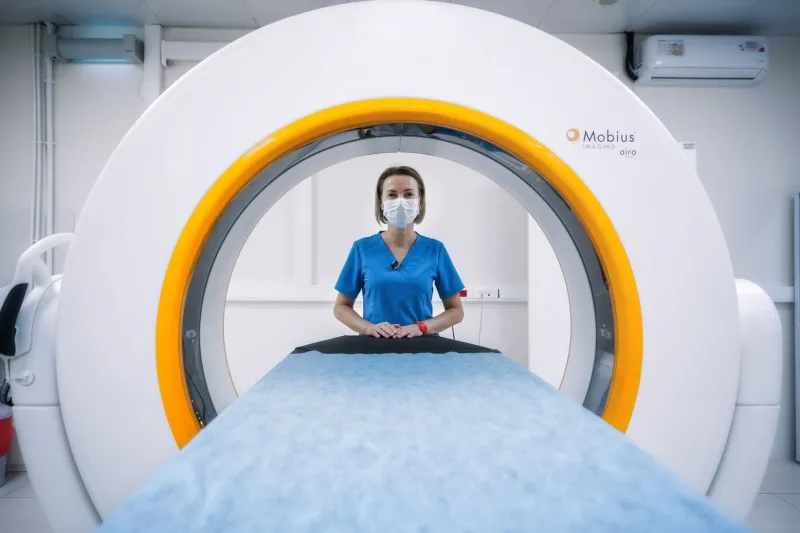
You get the letter, you park in a multi-storey, you answer a long list of questions about metal, and then you lie on a bed that slides you into a white plastic tunnel roughly the width of a pizza box lid over your face. It sounds like a road drill playing a drum solo. Twenty-five minutes later you're in the car park again with no obvious idea what just happened.
Quite a lot happened, as it turns out.
A magnet that is never switched off
A clinical MRI scanner runs at 1.5 tesla, or increasingly 3 tesla. For comparison, the Earth's field, the one that swings a compass needle, is around 50 microtesla — so a 1.5 tesla scanner is tens of thousands of times stronger. The stray field around one of these machines is genuinely dangerous: at the bore face a 1.5 tesla magnet will lift a car door, a hospital bed, an oxygen cylinder or a floor polisher and throw it down the tunnel. Every scanner room is a controlled area for that reason, and staff are trained never to carry so much as a lanyard clip past the line.
What makes it work is superconductivity. The coil wire is niobium-titanium alloy, wound into tens of kilometres of loops, and cooled into a cryostat filled with liquid helium at around 4 kelvin — near absolute zero. At that temperature the wire loses all electrical resistance, so a current, once started, can circulate for years without a power supply and without decaying. The magnet isn't switched on when you arrive. It's been on since 2014.
Keep hold of the helium detail. It comes back later, and it's the reason a scanner is a logistics problem as much as a physics one.
What it does to the water in you
Your body is mostly water, and water is mostly hydrogen nuclei — single protons. Each proton behaves like a tiny bar magnet with a north and south, spinning on its axis. Normally those spins point every which way, cancelling out.
Put the body in a strong field and the protons line up, mostly with the field, some against it. A weak population difference — a handful per million extra — is enough to work with. Then the machine fires a radiofrequency pulse at exactly the right frequency to tip them over. At 1.5 tesla that resonant frequency is about 63 megahertz, sitting in the same part of the spectrum as FM radio. The protons absorb the energy and flip, then relax back, releasing that energy as a signal a receiving coil can pick up.
That signal is the whole trick. Different tissues relax at different rates — fat comes back quickly, water slowly, and the machine turns those timings into the grey-and-white contrast radiologists read. Fast-switching gradient coils do the spatial encoding, using the same physics as a loudspeaker motor, so the machine can work out that this signal came from a slice 4 cm into the left temporal lobe.
The important safety point is what is absent. There's no ionising radiation. Unlike a CT scan, an MRI does not knock electrons off molecules in your DNA. The contrast comes from chemistry and timing, not from damage.
The bits you'll actually notice
- Noise. Gradient coils switching on and off make the coil assembly physically vibrate. Levels can reach around 100 decibels or more. Earplugs aren't a courtesy, they're protection, and you should keep them in.
- Tingling. Rapidly changing fields can stimulate peripheral nerves, so you may feel a twitch or a tapping sensation on your skin during some sequences.
- Warmth. The radiofrequency pulses deposit energy, and tissue temperature can rise slightly — usually by a fraction of a degree. The scanner calculates this continuously and won't let the dose go too far.
- Contrast agent. If you're given gadolinium, that's a separate drug, usually filtered out by the kidneys, with rare but real reactions worth reporting.
- Nothing permanent. Your atoms are nudged and released. You are not left magnetised, and you cannot magnetise your house keys by walking out of the room.
Metal is the genuine hazard, and it's why the pre-scan checklist is so long. Implants, surgical clips, fragments in eyes, tattoos with metallic pigment, older pacemakers. Many modern pacemakers are MR-conditional — meaning safe under specified conditions — but the radiographer has to verify the model, not take your word for it.
The frozen gas problem
A whole-body scanner holds somewhere between 1,500 and 2,000 litres of liquid helium, plus a cryocooler that recondenses most of what boils off. Even so, top-ups are sometimes needed, and a quench — a controlled or accidental boil-off — can dump a substantial fraction of the gas into the atmosphere in minutes.
That matters because helium is a finite by-product of natural gas extraction, and world supply has been repeatedly rattled: the 2018 US strategic reserve auction, the Amur plant in Russia coming online and going offline, and shipping disruptions since. Prices spiked hard, and hospitals with several scanners started to notice.
Manufacturers have responded by pushing the helium requirement down — low-helium and cryogen-free designs use far less, and better cryocooling makes boil-off close to zero. But retrofitting is not trivial, and the changeover is slowly making its way into UK imaging departments rather than arriving all at once.
Physical mass, physical rooms
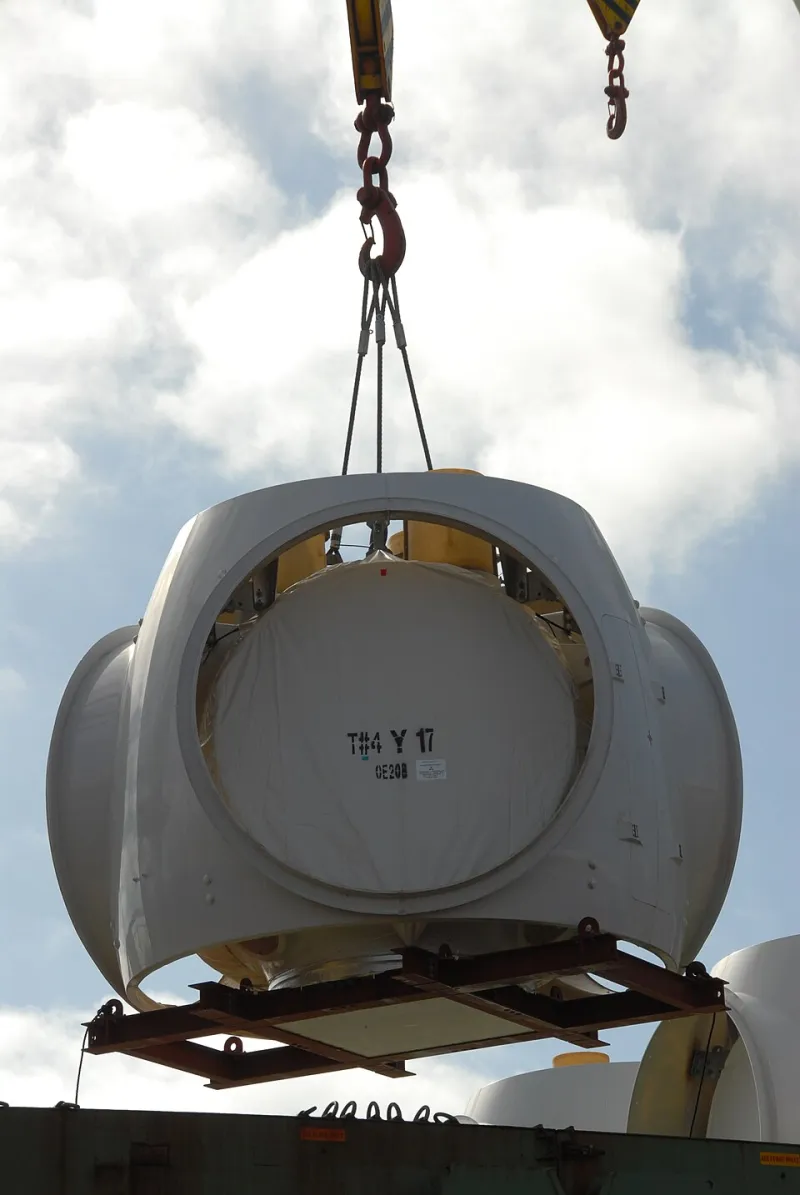
There's a prosaic side to this too. A scanner magnet assembly weighs several tonnes. It needs a shielded room lined with copper or steel to contain the radio frequencies, a high-strength floor, and a quench pipe running to open air so that boiled helium can vent safely. Siting one is a building project, not a delivery.
And then there's the throughput reality. A standard examination runs 20 to 40 minutes of scanner time, with cleaning and patient changeover either side. One machine might manage 15 to 20 patients in a long day. Add a national shortage of radiographers working the scanners and you have a bottleneck made of capital, cryogens and staff all at once.
Why the wait is a physics story
The UK has fewer MRI scanners per person than many comparable countries — broadly single figures per million, against figures roughly double that in parts of Europe and considerably more in Japan and the United States. Building back is slow, expensive and dependent on supplies of a gas that nobody can manufacture.
The upside is that diagnostic capacity has been moving to community diagnostic centres, which site scanners away from big hospital estates and nearer where people live. It's a lot of work for a machine whose central component is, at heart, a coil of alloy wire in a thermos.
What to do with this information
Not much, practically, except two things. Answer the metal questions honestly — the checklist exists for a reason that has nothing to do with box-ticking. And when the noise starts, remember what's going on: millions of protons in your water are lining up, tipping over and falling back, and a piece of wire cold enough to make air into a liquid is listening to them.
It's a strange way to look inside a person. It's also hard to imagine a better one.