Before the Fork: The Magnets Quietly Policing Britain's Dinner
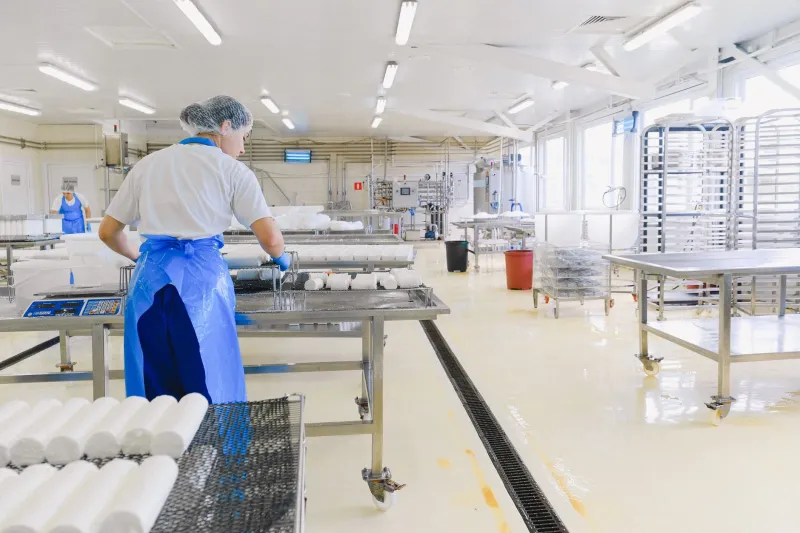
Somewhere in a British flour mill, a stainless-steel chute carries a pale river of powder towards a packing line. Nobody is watching it particularly closely. But inside that chute, a set of rare-earth magnets is doing a job that rarely makes the news and matters enormously: catching stray metal before it ends up in a loaf.
This is magnetic separation, the unglamorous end of materials science. It is not glamorous. It is not new. But in a food system built on speed and scale, it is one of the quietest safety nets we have.
The bouncers at the start of the line
Food factories use magnets in several unremarkable shapes. Plate magnets sit in chutes, angled so product slides across them. Grate magnets — arrays of magnetic tubes — drop into hoppers and bins, letting powder or grain trickle between the bars. Pipeline magnets handle liquids and pastes. Drum magnets and magnetic head pulleys catch metal on conveyor belts.
The magnets themselves are often neodymium-iron-boron, the same family of rare-earth magnets that make headphones thump and wind turbines turn. In food equipment they are usually sealed inside stainless-steel housings, because a magnet that sheds its own coating is not a safety device; it is a new contaminant.
Their job is simple to describe: attract ferrous metal — iron and most steels — and hold it until someone cleans the equipment. The field near the surface can be strong enough to make a fridge magnet feel like a polite suggestion, but strength alone is not the point. Placement is. Product needs to pass close to the magnet, in a thin, even layer, at a sensible speed. A magnet buried under a foot of flour is mostly decoration.
Ferrous first, and the stainless steel problem
Magnetic separation is very good at the easy cases. A broken piece of mild-steel machinery, a stray screw, a fragment of wire — these are ferromagnetic, and a decent magnet will grab them.
Then things get awkward. Aluminium, copper, brass and lead are not magnetic. Neither, in most practical food-factory conditions, are the common austenitic stainless steels such as 304 and 316. Those alloys are used everywhere precisely because they resist corrosion, and their crystal structure often leaves them weakly magnetic at best. A piece of 316 stainless steel can sail past a magnet with the calm of a commuter ignoring a charity collector.
That is why magnets are rarely the only line of defence. Metal detectors and X-ray inspection systems catch different things. A balanced-coil metal detector responds to conductive materials, including non-ferrous metals and many stainless steels. X-ray can spot dense fragments by shape and density. Each technology has blind spots; together they cover more ground. A magnet is a filter, not a guarantee.
Why a fragment the size of a grain of rice matters
In the UK, food safety law and industry standards such as HACCP and BRCGS push factories to identify physical hazards and put controls in place. A metal fragment is a classic physical hazard: unpredictable, potentially injurious, and impossible to reassure your way out of once it has reached a plate.
Even a small piece can trigger a recall. The Food Standards Agency publishes recall notices throughout the year, and the reasons are often mundane — a bit of machinery, a piece of wire, a foreign body found during production. The cost is not just money. Recalls involve traceability exercises, retailer pressure, waste and reputational damage. For a factory, the arithmetic of a magnet is straightforward: it is cheap insurance until the day it is not there.
The cleaning ritual
A magnet that is never cleaned is just a shelf with a magnetic personality. Once the surface is covered in iron filings and swarf, fresh metal has nowhere to stick. Factories therefore clean magnets on a schedule — often every shift, or more frequently on high-risk lines — and record what they find.
The inspection matters as much as the cleaning. A tidy little beard of ferrous dust might be normal wear. A larger fragment, or a sudden change in the pattern, is a clue that something upstream is wearing out. In that sense, a magnet is also a crude diagnostic tool: it tells you what your machinery is shedding.
Testing the net
Factories do not simply trust the magnet. They challenge it. Test pieces — a ferrous slug, a non-ferrous sample and a stainless-steel sample — are passed through the line at set intervals to confirm the detection system still responds. The exact routine depends on the factory and the standard it works to, but the principle is universal: prove the control works, then write it down.
This is where the limits become visible. A test piece has a known size and composition. Real contamination is messier. It might be a thin sliver of stainless steel, a lump of aluminium foil, or a fragment buried inside a clump of product. Magnets do well against ferrous metal; they are much less impressive against the rest.
What magnets cannot do
It is worth being clear about the boundaries. Magnetic separation does not sterilise food, detect every metal, or replace good hygiene and maintenance. It will not reliably catch non-magnetic metals, and it can be defeated by product flow that is too fast, too deep or too clumpy. It also depends on people: on cleaning schedules being followed, on equipment being checked, on a factory culture that treats a stray fragment as a serious event rather than an inconvenience.
None of that makes magnets less useful. It makes them part of a system. The best food factories treat magnetic separation as one layer in a sandwich of controls — supplier checks, sieving, metal detection, X-ray, maintenance and traceability — rather than a magic wand at the end of the line.
The quiet job
Next time you tear open a bag of flour or peel the film off a ready meal, picture the journey upstream. Somewhere in a mill or factory, a magnet did its small, silent job. It probably caught nothing at all. That is the point. The best safety equipment in Britain's food chain is often the equipment you never notice, quietly holding the line before your dinner reaches the fork.