The Sky Above Britain Is Waking Up: The Magnetic Physics Behind 2026's Aurora Surge
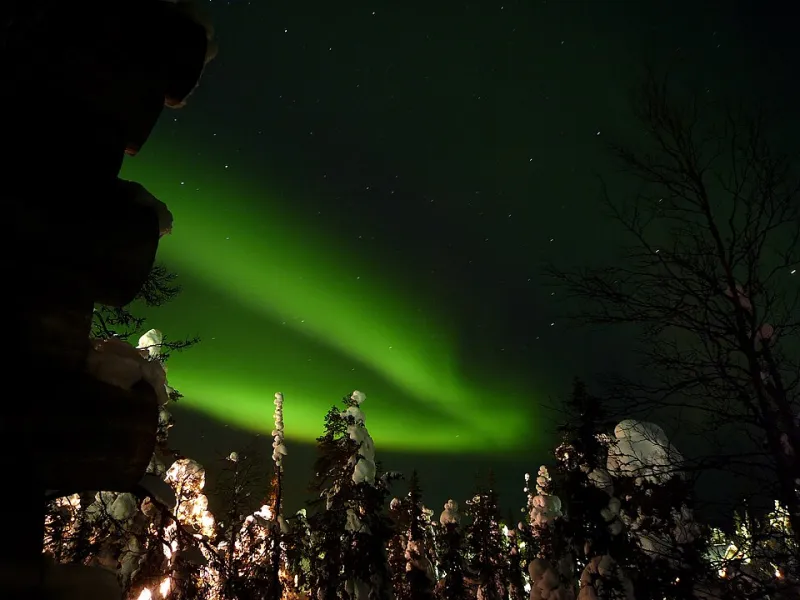
Photo: Timo Newton-Syms, CC BY-SA 2.0, via Wikimedia Commons
There is a particular kind of British evening that aurora hunters know well. You drive forty minutes past the last streetlight, stand in a field with the collar of your coat up, and wait. Nothing happens. Then your phone camera — left on a long exposure out of habit — picks up a faint green smear on the northern horizon that your eyes can barely register. That smear is the tail end of a journey that began 150 million kilometres away.
And in 2026, more of us are getting that moment than at almost any point in the past two decades.
A star with a heartbeat
The Sun does not shine steadily. Its activity rises and falls on a roughly eleven-year rhythm, tracked by the number of sunspots freckling its surface. Those dark patches are knots of intense magnetic field, and where the field gets tangled enough, it snaps — flinging clouds of charged particles out into the solar system as coronal mass ejections.
The present cycle, the twenty-fifth since reliable record-keeping began, climbed to its busy phase across 2024 and 2025. Even as it eases off its peak, 2026 remains well inside the elevated stretch, and the tail of a solar cycle is not a quiet place. Big storms can arrive at almost any point, and the coronal holes that stream fast solar wind towards us tend to be well placed during the declining years.
The result is a Sun that keeps lobbing material in our direction. What happens next is the interesting bit.
The invisible shield doing the steering
Earth is wrapped in a magnetic bubble called the magnetosphere, generated by churning liquid iron in the outer core. It is not a passive shield. When a gust of solar wind hits it, the field lines on the sunward side compress, and some of them snap and reconnect, flinging plasma down towards the poles along magnetic field lines.
Those particles — mostly electrons, moving at a fair fraction of the speed of light — slam into oxygen and nitrogen atoms 100 to 300 kilometres above the ground. The atoms get excited, then relax, releasing that energy as light. Oxygen at high altitude glows a deep blood red; lower down it produces the familiar green. Nitrogen adds blues and purples at the fringes.
The colours are chemistry, but the shape is magnetism. Auroras form a ring around each magnetic pole, and it is that ring — the auroral oval — that decides whether a display is a Shetland special or something a farmer in Norfolk happens to notice over the barn.
Why the lights keep creeping south
The oval is not fixed. Feed it more energy and it expands, sometimes dramatically, pushing its southern edge down through Scotland, northern England, and in the strongest events well into the Midlands and beyond. The extraordinary geomagnetic storm of May 2024, one of the strongest in two decades, produced naked-eye reports from places that had not seen aurora in a generation.
Three things have shifted since the quiet years of the late 2010s. First, the Sun is simply more active. Second, the equinox periods around March and September bring a well-known quirk of geometry — the Russell-McPherron effect — that lets solar magnetic fields couple to Earth's more efficiently, which is why aurora season peaks around those months rather than at midwinter. Third, and least romantic but most practical: our ability to record faint displays has improved enormously. Modern phone sensors can capture a green glow that human eyes, tuned for colour in bright light, read as a pale grey wash.
So some of the apparent increase is physics, and some of it is cameras. Both are real. Neither is a reason to dismiss what people are seeing.
A realistic guide to spotting one from Britain
Aurora chasing in the UK is mostly a game of odds management. Weather is the enemy that defeats most attempts — a clear northern horizon matters more than any app.
- Go dark and go north. Kielder Forest in Northumberland, Galloway Forest Park in Scotland, Exmoor, the Yorkshire Dales and the north Norfolk coast all offer genuinely dark skies. Face north, get low ground and trees out of your sightline, and give your eyes twenty minutes to adapt.
- Watch the alerts, not the forecasts. The Met Office runs a space weather service, and AuroraWatch UK, built at Lancaster University, sends out geomagnetic activity alerts based on magnetometer readings from across the country. A spike in the Kp index is your cue, not a guarantee.
- Use the camera as a scout. Rest your phone against something solid, switch to night mode, and take a ten-second exposure. If a green or purple wash appears, you are looking at the right patch of sky — and your eyes may catch up.
- Mind the Moon. A bright Moon washes out faint structure. Around new Moon is worth waiting for.
What the labs are watching
Behind the public spectacle sits a quieter research effort. Magnetometers dotted across the UK continually measure the tiny wobbles in Earth's field that accompany a storm, and those readings feed models of how the auroral oval behaves. It is unglamorous work — a lot of instrument maintenance and data cleaning — but it is why a forecast can now tell you, hours ahead, that a disturbance is likely.
Standing in that field, though, the science is not really the point. The point is that a star 150 million kilometres away is rattling the magnetic bubble you live inside, and every so often it drags a curtain of green light over a British hedgerow. Keep the coat handy. Keep looking up.